Your road bike frame size depends mainly on your height and inseam. Measure your inseam in centimeters, multiply by about 0.65, and cross-check the result against the brand's size chart before buying.
Getting your road bike frame size right changes how a bike feels from the first pedal stroke. The correct fit boosts comfort, power transfer, and control on every ride.This guide gives you the exact numbers you need. You’ll find a size chart, simple measuring steps, and the fit checks pro bike fitters actually use.
What Size Road Bike Do I Need?
Your road bike frame size depends mainly on your height and inseam. Measure your inseam in centimeters, multiply it by roughly 0.65, and you’ll land close to your ideal frame size in centimeters. Always cross-check that number against the brand’s own size chart before you buy, since sizing shifts between manufacturers.
Road Bike Frame Size Chart by Height and Inseam
Use the chart below as your starting point. Inseam is the more reliable number, since two riders of the same height can still have very different leg lengths.
Road Bike Size Chart in Centimeters
Height (cm)
Inseam (cm)
Frame Size (cm)
152–160
71–75
47–48
160–168
74–79
50–52
168–175
78–82
52–54
175–183
81–86
54–56
183–191
84–90
56–58
191–198
89–93
58–60
Road Bike Size Chart in Inches
Height (ft/in)
Inseam (in)
Frame Size
5’0″–5’3″
28″–29.5″
XS
5’3″–5’6″
29″–31″
S
5’6″–5’9″
30″–32″
M
5’9″–6’0″
31″–34″
L
6’0″–6’3″
33″–35″
XL
6’3″–6’6″
34″+
XXL
These ranges line up closely with published charts from Trek, The Bike Shoppe, and Ridley’s Cycle. Still, treat any chart as a rough guide. Frame geometry, not just the size label, decides the real fit.
How to Measure Your Height and Inseam for Road Bike Sizing
Learn how to measure your height and inseam correctly and use inseam measurements to estimate the right road bike frame size.
Two numbers matter here. Both take under two minutes with a tape measure.
How to Measure Your Height
Stand against a wall with bare feet. Keep your back straight and look forward. Mark the wall at the top of your head, then measure from the floor to that mark.
How to Measure Your Inseam
Stand with your feet about 6 inches apart, back against a wall. Place a book between your legs, spine up, until it touches your crotch like a saddle would. Mark the wall at the top of the book, then measure down to the floor.
A quick sizing formula many fitters use: multiply your inseam in centimeters by a factor between 0.65 and 0.69 to estimate your road frame size in centimeters. An 80cm inseam, for example, lands you close to a 52–55cm frame. It’s a fast starting point, not a final answer.
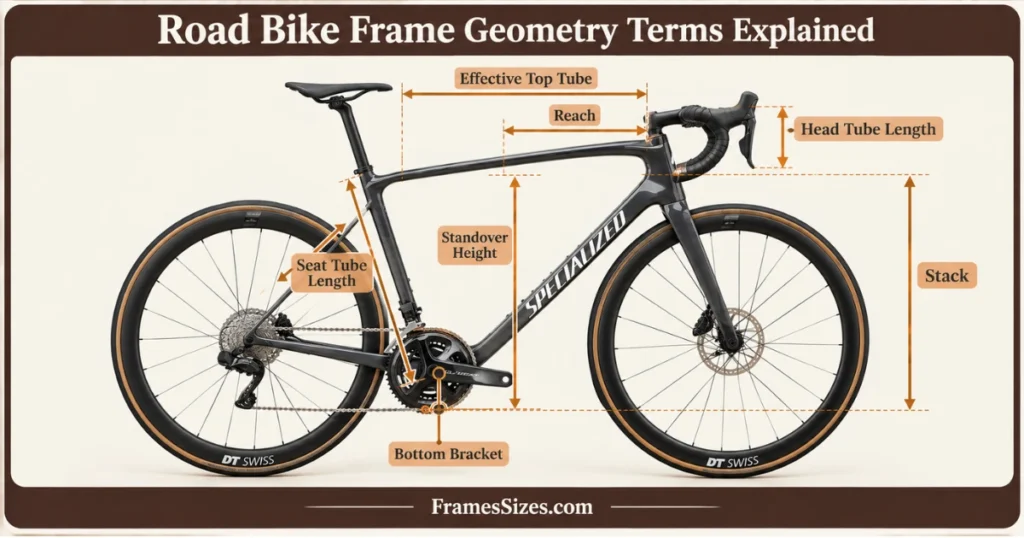
A visual guide to the key road bike frame geometry measurements used to understand bike fit and sizing.
Frame size alone doesn’t tell the whole story. These geometry terms explain why two bikes labeled the same size can fit completely differently.
Standover Height
This is the clearance between your body and the top tube when you stand over the bike. BikeThomson and REI both point to roughly 1 to 2 inches of clearance on a traditional road frame, with more room needed on a sloping or compact design.
Stack and Reach
Stack is the vertical distance from the bottom bracket to the top of the head tube. Reach is the horizontal distance between those same two points. Together, they’re the most reliable way to compare fit across brands, since a “54cm” label doesn’t guarantee the same stack or reach anywhere else.
Effective Top Tube Length
This measures how far you stretch to reach the handlebars. A longer top tube stretches your body forward. A shorter one keeps you more upright.
Seat Tube and Head Tube Length
Seat tube length is the traditional way road bikes were sized, running from the bottom bracket to the top of the seat tube. Head tube length controls how high or low your handlebars sit. A longer head tube raises your front end for a more relaxed position.
Race Geometry vs. Endurance Geometry: Which Fits Your Road Bike Frame Size
Compare race and endurance road bike geometry to understand differences in stack, reach, aerodynamics, and riding position.
Your riding style changes which frame size and geometry fits best, even at the same height.
Race geometry features a lower stack and longer reach. It puts you in a low, stretched, aerodynamic position built for speed and competitive riding. Endurance geometry raises the stack and shortens the reach slightly, keeping your back and neck more upright for multi-hour rides.
What to Do If You’re Between Two Road Bike Frame Sizes
This happens often, since road bike frame size charts overlap. A few simple rules help:
Size up if you have long arms or a long torso relative to your height
Size down if you want a lighter, more responsive, race-ready feel
Size down if you prefer an upright, relaxed riding position with a shorter reach
A shorter or longer stem can fine-tune your reach after you’ve picked a frame. It won’t fix a frame that’s the wrong size to begin with.
Signs Your Road Bike Frame Size Is Wrong
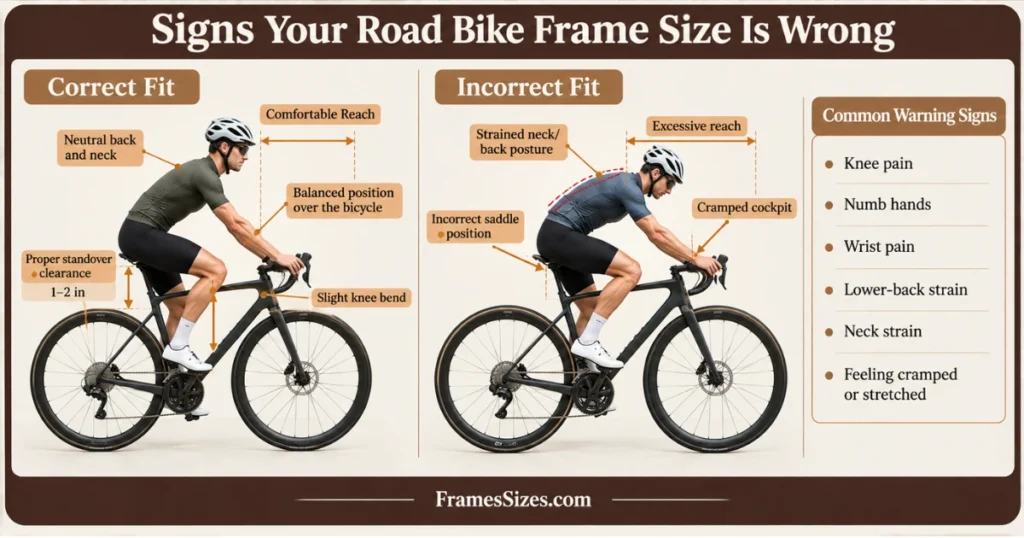
Compare correct and incorrect road bike fit to identify common signs of an improperly sized frame.
A poorly sized road bike shows up in your body before it shows up on paper. Research on cycling overuse injuries found that 85% of cyclists experience at least one overuse injury, with poor bike fit named as a leading cause (UNC bike fit and knee pain study).
Watch for these warning signs:
Knee pain at the front (frame too small, saddle too low) or back of the knee (frame too big, saddle too high)
Numb hands or constant wrist pain from overreaching to the handlebars
Lower back or neck strain after short rides
Toe overlap with the front wheel on tight turns
Feeling cramped or stretched out no matter how you adjust the saddle
If two or more of these sound familiar, the issue is often frame size, not just a component adjustment.
How to Confirm Your Road Bike Frame Size Before You Buy
Cross-Check the Brand’s Geometry Chart
Every reputable road bike brand, including Cannondale and HED Cycling, publishes a full geometry chart. Compare stack, reach, and seat tube numbers against your current bike or a professional fit session.
Test Ride Before You Commit
Nothing replaces time in the saddle. REI’s bike fitting guide recommends checking your knee bend, reach, and standover clearance while actually riding, not just standing over the frame in a shop.
Get a Professional Bike Fit
A professional bike fit gives you exact stack, reach, and saddle height numbers. Those numbers carry over to any brand you shop, making future purchases far more accurate.
Match your height to the chart above, then confirm with your inseam measurement. Inseam is the more accurate number of the two.
What’s the right road bike size for me?
The right size gives you 1–2 inches of standover clearance, a slight bend in your knee at the bottom of the pedal stroke, and a comfortable reach to the handlebars without straining your back.
What size is a 54cm road bike?
A 54cm road bike typically fits riders between roughly 5’6″ and 5’9″ tall, though this varies by brand.
What size is a 52cm road bike?
A 52cm road bike usually fits riders between roughly 5’3″ and 5’6″ tall.
What size is a 58cm road bike?
A 58cm road bike generally suits riders between roughly 5’9″ and 6’0″ tall.
I’m between sizes — which way should I go?
Size down for a lighter, more aggressive fit. Size up for a more relaxed, comfortable riding position.
Should your feet touch the ground?
Not fully. Your toes should barely reach the ground while seated. Flat feet on the ground usually means your saddle sits too low.
Should your legs be straight when pedaling?
No. Aim for a slight bend, roughly 25–35 degrees, at the bottom of the pedal stroke. A fully locked knee strains the joint over time.
How much does a bike fitting cost?
Professional bike fits vary by shop and typically range from a basic fit check to a full multi-hour session with video analysis. Contact a local bike shop for exact pricing in your area.
Conclusion
The right road bike frame size starts with two honest measurements, gets refined by geometry, and gets confirmed with a real test ride. Skip the guesswork, measure carefully, and check the brand’s geometry chart before you buy.
Hi, I’m Adrian Blackwell, the author at FramesSizes.com. I help simplify measurements, dimensions, and frame sizes with easy guides and clear explanations — so you can understand sizes quickly and accurately.