To find your bike frame size, match your height to a general size chart, then confirm with your inseam (multiply by 0.65 for road bikes). Check standover height for final confirmation, then adjust for your bike type — road, mountain, or hybrid — to lock in the best fit.
This guide breaks down bike frame size in plain language. You’ll learn how to measure yourself, read a bike frame size chart, and pick the correct fit for the type of bike you ride.
What Is Bike Frame Size?
Learn how bike frame size is measured from the bottom bracket to the seat tube and why it differs from wheel diameter.
Bike frame size is the measurement of a bike’s frame, not its wheels. It tells you how big the frame is between key points, like the bottom bracket and the top of the seat tube.
A 2008 survey by Transport for London and cycling ergonomics firm CycleFit found that 71% of London’s cyclists were riding badly-fitting bikes, with wrong saddle height as the top mistake. Getting your frame size right from the start avoids this problem entirely.
Why Bike Frame Size Isn’t Consistent Across Brands
A “54 cm” frame from one brand is not always the same as a “54 cm” frame from another. Manufacturers like Trek, Specialized, Giant, and Cannondale each measure their seat tubes from slightly different reference points.
This means a bike frame size chart is a strong starting point, but it’s not the final word. Always cross-check the exact frame geometry listed on the specific model you’re considering.
Bike Frame Size Chart by Height
Height is the fastest way to estimate your bike frame size. Use the chart below as a general starting point before narrowing down by bike type.
Rider Height
Frame Size (cm)
General Label
4’10” – 5’2″
47 – 50 cm
XS
5’2″ – 5’6″
50 – 52 cm
S
5’6″ – 5’9″
52 – 54 cm
M
5’9″ – 6’0″
54 – 56 cm
M/L
6’0″ – 6’3″
56 – 58 cm
L
6’3″ and up
58 – 61 cm
XL
Think of this as a rough map, not a fixed address. Your inseam length will sharpen the estimate.
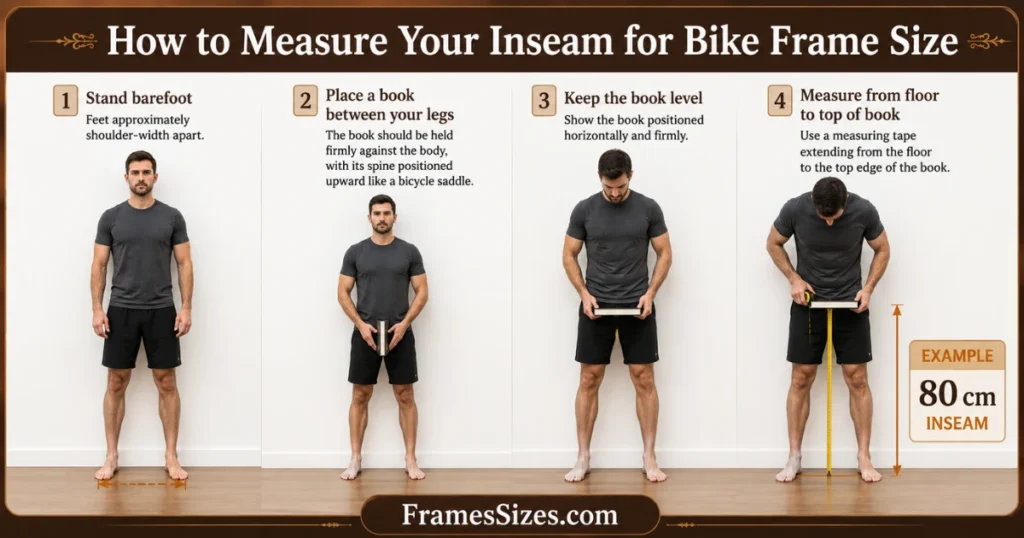
How to Measure Your Inseam for Bike Frame Size
Learn how to accurately measure your inseam for bike frame sizing using a book and measuring tape.
Your inseam matters more than height because it reflects your actual leg length, which drives standover clearance and saddle position.
Stand barefoot with your back against a wall, feet shoulder-width apart.
Place a book firmly between your legs, spine up, as if it were a saddle.
Measure from the floor to the top of the book in centimeters.
Write this number down. You’ll use it directly in the next step.
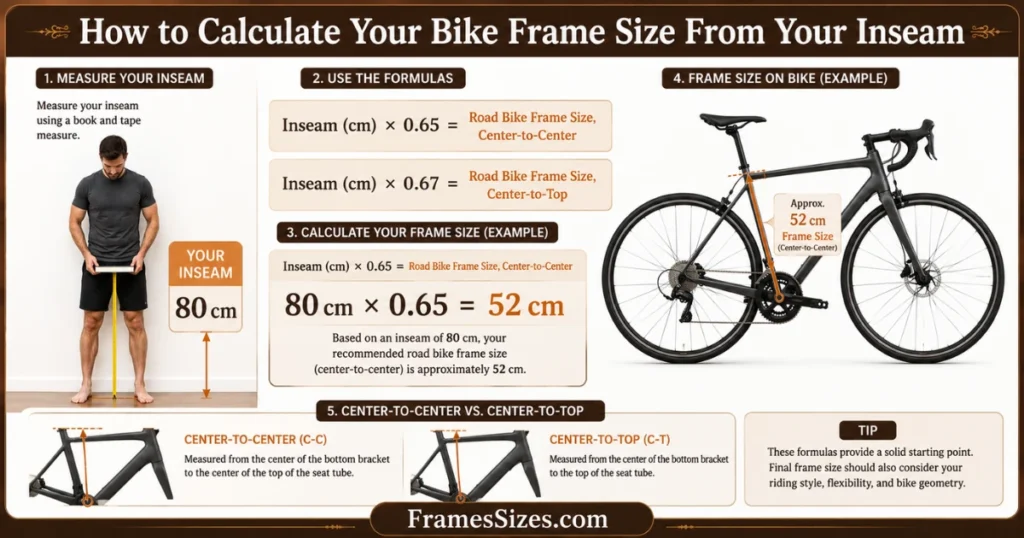
How to Calculate Your Bike Frame Size From Your Inseam
Calculate your bike frame size from your inseam using the 0.65 and 0.67 formulas, with an 80 cm inseam example.
Once you have your inseam, you can calculate a bike frame size estimate using a well-known cycling formula. It was developed in the early 1980s by Cyrille Guimard, the coach of pro cyclist Greg LeMond, and is still referenced by bike fitters today.
Inseam (cm) x 0.65 = road bike frame size, center-to-center
Inseam (cm) x 0.67 = road bike frame size, center-to-top
For example, an 80 cm inseam gives you roughly a 52 cm frame using the first formula. Taller riders (over 6 feet) sometimes need to size up slightly from this number for a more comfortable reach.
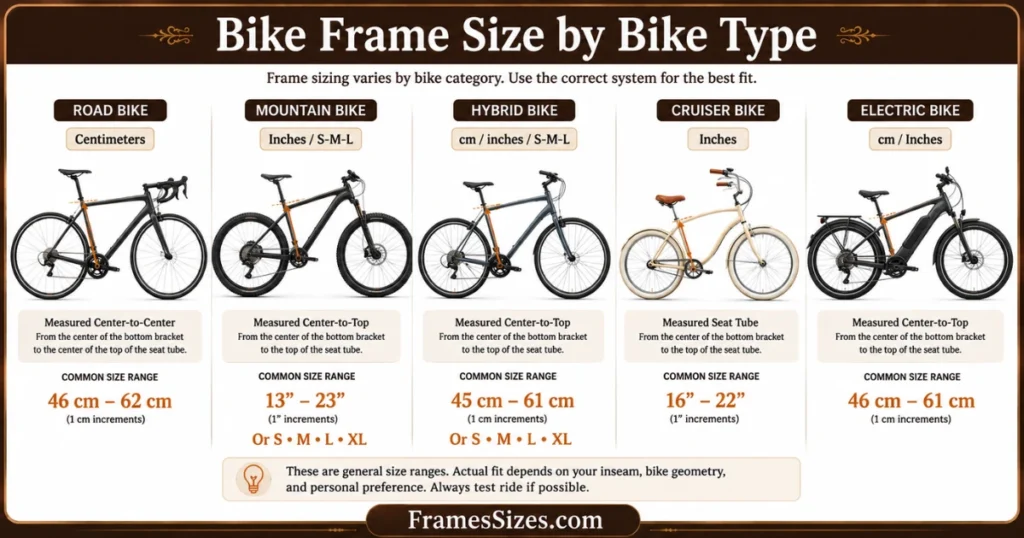
Bike Frame Size by Bike Type
Compare bike frame sizing systems for road, mountain, hybrid, cruiser, and electric bikes.
Bike frame size isn’t universal across bike categories. Each type uses its own sizing logic based on how the bike is meant to be ridden.
Road Bike Frame Size
Road bikes are usually sized in centimeters, based on seat tube length. They favor a lower, more stretched-out riding position, so reach matters as much as height here.
Mountain Bike Frame Size
Mountain bikes are typically sized in inches or with S/M/L labels. Because trail riding demands more standover clearance, mountain bike frames often run smaller relative to a rider’s height than road frames do.
Hybrid Bike Frame Size
Hybrid bikes blend road and mountain traits, so sizing can appear in centimeters, inches, or S/M/L, depending on the brand. A more upright riding position makes hybrid sizing more forgiving than road bike sizing.
Cruiser Bike Frame Size
Cruisers use a relaxed, upright frame geometry, which means riders often fit comfortably across a wider size range. Precision matters less here than on performance bikes.
Electric Bike Frame Size
Electric bikes generally follow standard bike frame size rules, but added battery weight and wider tires (especially on fat-tire e-bikes) can shift the bike’s balance. Always check the specific model’s weight limit and geometry chart.
Standover Height and Bike Frame Size
Understand standover clearance and how much space you need between your body and the bike’s top tube.
Standover height is the distance between the top tube and the ground. It’s a quick safety check for bike frame size, especially if you ever need to stop suddenly and put your feet down.
Stand over the bike with both feet flat on the ground. You want roughly 1–2 inches of clearance for road and hybrid bikes, and closer to 3 inches for mountain bikes, which need extra room for rough terrain.
Stack, Reach, and Effective Top Tube
Understand stack, reach, and effective top tube to compare road bike fit beyond the frame-size label.
Stack and reach measure a frame’s actual shape, not just a nominal number on a sticker. Stack is the vertical distance from the bottom bracket to the top of the head tube. Reach is the horizontal distance between those same two points.
Effective top tube length is another precise way to compare frames, since it reflects the real horizontal distance a rider stretches across, regardless of what size label the manufacturer used. Comparing stack, reach, and effective top tube across brands gives a far more reliable picture than comparing nominal frame sizes alone.
Parts of a Bike Frame
Knowing these terms makes every bike frame size chart easier to read.
Top tube – horizontal bar connecting the head tube to the seat tube
Head tube – front section of the frame that holds the fork
Seat tube – vertical tube that holds the seatpost; the main sizing reference point
Down tube – diagonal tube linking the head tube to the bottom bracket
Bottom bracket – housing that allows the crankset to rotate
Chain stay – tubes connecting the bottom bracket to the rear axle
What to Do If You’re Between Bike Frame Sizes
Being between two bike frame sizes is common and manageable. The right choice depends on your riding style, not just the numbers.
Size down if you want quicker handling, more control on technical terrain, or a lighter, stiffer feel.
Size up if you ride longer distances, want a more stretched-out position, or have a longer wingspan relative to your height.
Signs Your Bike Frame Size Is Wrong
Learn the key signs of a poor bike frame fit and what a more balanced riding position looks like.
A study published in the Revista Brasileira de Cineantropometria e Desempenho Humano found body position misalignment in 82% of recreational cyclists studied, most often tied to saddle position. Watch for these warning signs on your own bike:
Persistent back, wrist, or knee pain
Knees brushing the handlebars while pedaling
Feeling cramped or overly stretched while riding
Little to no standover clearance
Bike Frame Size vs Kids’ Bike Sizing
Bike frame size applies to adult bikes. Kids’ bikes work differently and are sized by wheel diameter instead, typically 12″, 16″, 20″, or 24″ wheels based on the child’s age and height.
Don’t apply an adult bike frame size chart to a child’s bike. The two systems measure completely different things.
Questions About Bike Frame Size
What size bike frame do I need for my height?
Match your height to a general bike frame size chart first, then refine your choice using your inseam measurement and the specific bike type you’re buying.
How do I measure my inseam for bike frame size?
Stand barefoot against a wall, place a book between your legs like a saddle, and measure from the floor to the top of the book in centimeters.
Should my feet touch the ground on a bike?
You should be able to touch the ground with your toes while seated. If your whole foot sits flat on the ground, your saddle is likely too low.
Should my legs be straight when riding a bike?
No. Your knee should have a slight 15–20 degree bend at the bottom of the pedal stroke. Fully straight legs usually mean the frame or saddle height is off.
What if I’m between bike frame sizes?
Size down for quicker, more agile handling, or size up for a more stretched, stable riding position. Your riding style should guide the final call.
How do I know if I’ve purchased the wrong bike frame size?
Watch for knee or back pain, cramped pedaling, knees hitting the handlebars, or too little standover clearance. Any of these point to an incorrect frame size.
What Size Bike Frame Do I Need?
The right bike frame size depends mainly on your height and inseam. Use a bike frame size chart by height to find the recommended frame size, then check the bike manufacturer’s sizing guide.
How Do You Measure for a Bike Frame Size?
Measure your inseam length from the floor to your crotch while standing barefoot. Combine your inseam and height with a bike frame size chart to choose the correct size.
What Size Person Is a 19-Inch Frame Bike For?
A 19-inch bike frame generally suits a rider around 5’8″–6’0″, depending on the bike type and geometry. Always compare your height and inseam with the manufacturer’s sizing chart.
How Do You Determine Bike Frame Size?
To determine bike frame size, measure your height and inseam, then compare them with a bike sizing chart by height and inseam. Road, mountain, and hybrid bikes may use different sizing systems.
How Do You Measure Mountain Bike Frame Size?
For mountain bike frame size, measure the frame’s seat tube from the center of the bottom bracket to the top of the seat tube. For the best fit, also check your height and inseam against a mountain bike frame size chart.
What Size Person Is a 20-Inch Frame Bike For?
A 20-inch bike frame is generally suitable for riders around 5’10″–6’2″, but the ideal size varies by bike geometry. Check your inseam and the manufacturer’s bike size guide before buying.
What Size Person Is an 18-Inch Frame Bike For?
An 18-inch bike frame commonly fits riders around 5’6″–5’10”. Your inseam and the type of bike can change the recommended size.
What Size Person Is a 17-Inch Frame Bike For?
A 17-inch bike frame generally fits riders around 5’4″–5’8″, depending on the bike style and geometry. Use your height and inseam for a more accurate correct bike frame size.
Conclusion
Finding the right bike frame size comes down to a few honest measurements: your height, your inseam, and the type of bike you plan to ride. Combine a bike frame size chart with a standover check, and you’ll walk into your next ride with real confidence in your fit.
Hi, I’m Adrian Blackwell, the author at FramesSizes.com. I help simplify measurements, dimensions, and frame sizes with easy guides and clear explanations — so you can understand sizes quickly and accurately.