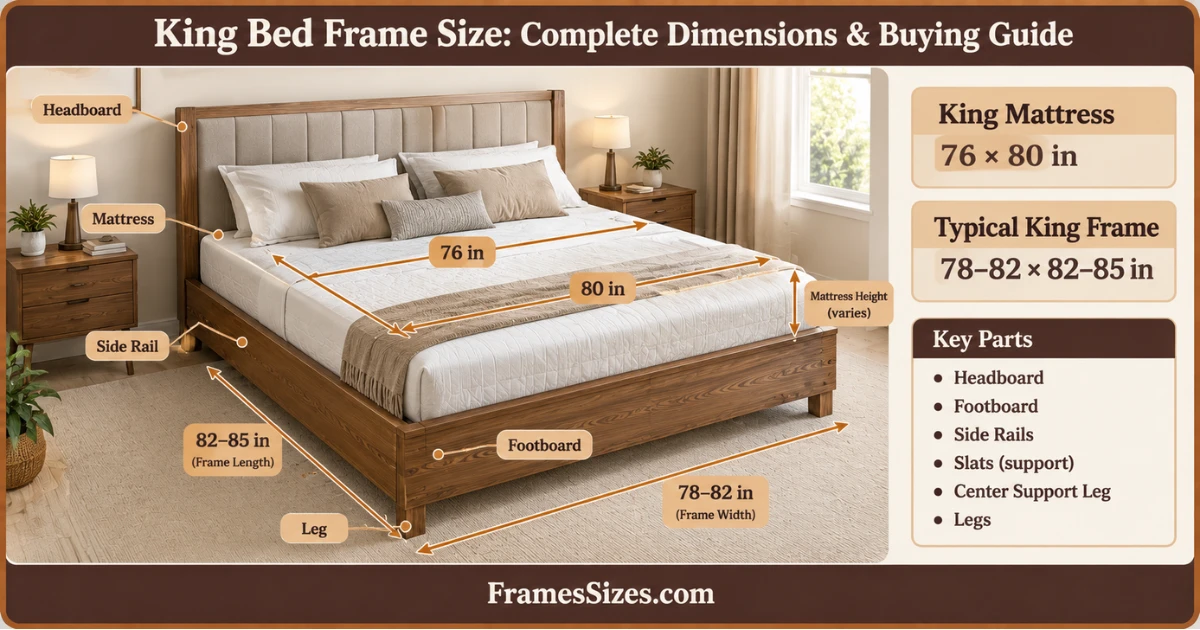
A king bed frame size typically measures 78 to 82 inches wide by 82 to 85 inches long. That’s a few inches bigger on every side than the 76-by-80-inch king mattress it’s built to hold.
This guide breaks down the exact king bed frame dimensions, how they stack up against other bed sizes, and how much room you actually need before you buy.
What Is the Standard King Bed Frame Size?
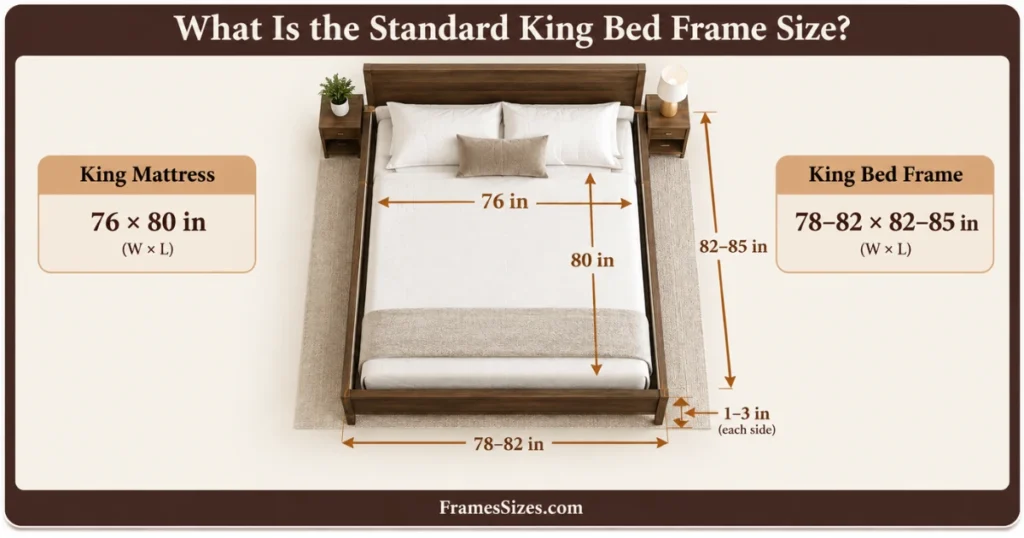
Standard king mattress and king bed frame dimensions with width and length measurements.
The standard king bed frame size runs 78 to 82 inches wide and 82 to 85 inches long. That extra room comes from the rails, headboard, and footboard wrapping around the mattress itself.
Retailers like Purple and Casper both size their king frames this way, though the exact overhang can shift by an inch or two depending on the frame’s style.
King Bed Frame Size Chart
Size
Mattress (in)
Frame (in)
Recommended Room
Twin
38 x 75
40-43 x 77-80
7 x 10 ft
Full
54 x 75
56-59 x 77-80
9.5 x 10.5 ft
Queen
60 x 80
62-65 x 82-85
10 x 10 ft
King
76 x 80
78-82 x 82-85
12 x 12 ft
California King
72 x 84
74-79 x 86-89
12 x 12 ft
King Bed Frame Size vs King Mattress Size
A king mattress size is 76 inches wide by 80 inches long. The frame wrapped around it adds roughly 2 to 6 inches total, depending on the manufacturer and design.
That gap matters more than it seems. Per Statista data cited by Purple, king mattresses are the second most-owned bed size among US adults, right behind queen. Mismatching the frame is one of the most common mistakes buyers make when sizing up.
King Bed Frame Size Compared to Other Bed Sizes
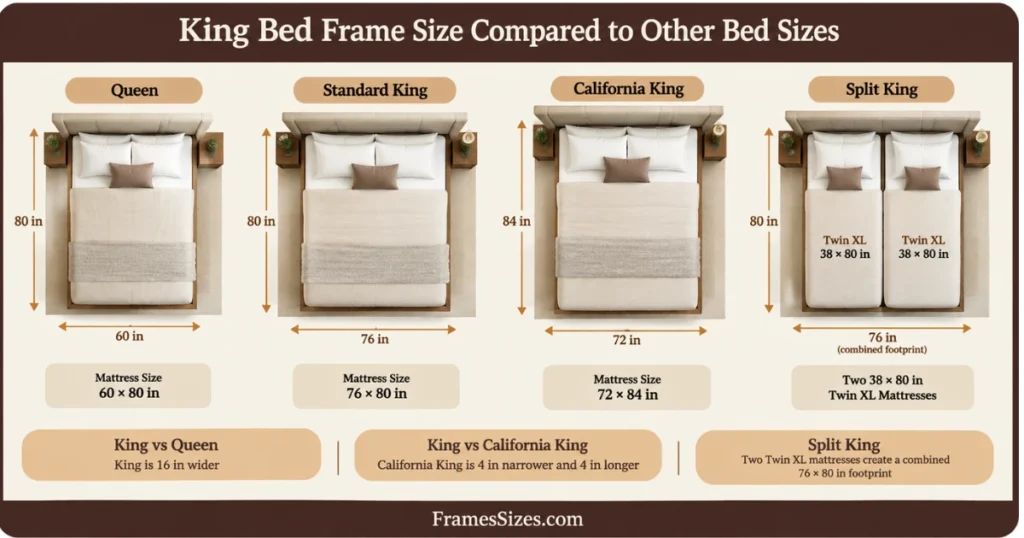
Compare King, Queen, California King, and Split King mattress sizes with accurate dimensions and proportions.
King vs Queen Bed Frame Size
A king frame is a full 16 inches wider than a queen frame, though both run the same 82-85 inch length. That extra width is why couples who feel cramped in a queen often jump straight to king.
King vs California King Bed Frame Size
A California king frame runs about 4 inches narrower but 4 inches longer than a standard king. Taller sleepers over 6 feet usually prefer that extra legroom.
King vs Split King Bed Frame Size
A split king bed frame shares the same outer footprint as a standard king, but the mattress is really two Twin XL mattresses (38 x 80 inches each) placed side by side. Couples choose this setup for independent firmness or separate adjustable bases.
King vs Oversized King Sizes
Beyond standard king sits a tier of oversized beds: Wyoming King (84 x 84 inches), Texas King (80 x 98 inches), Alberta King (96 x 96 inches), and Alaskan King (108 x 108 inches). Casper notes these oversized mattress sizes are hard to find outside specialty shops and usually need a custom-built frame to match.
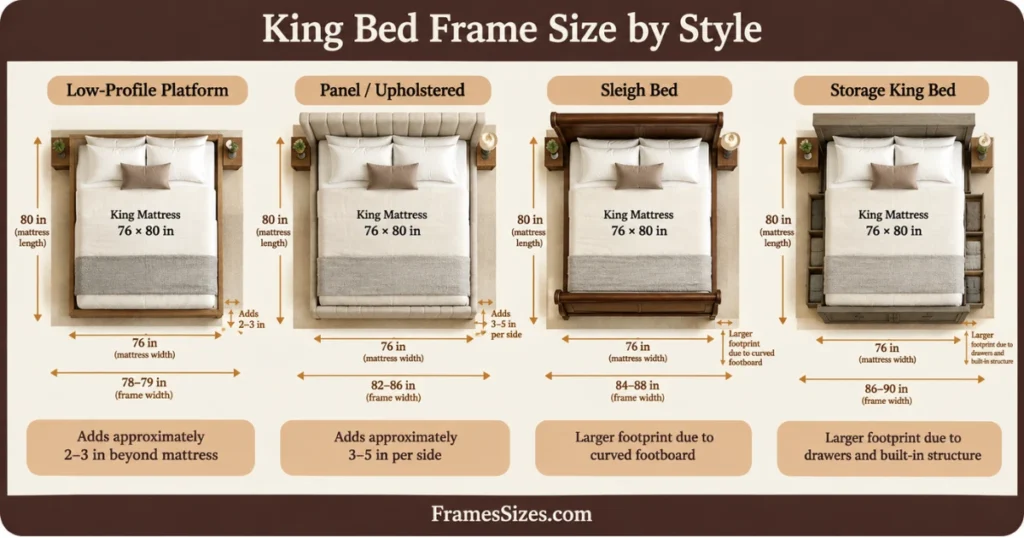
Compare king bed frame sizes by style and see how platform, upholstered, sleigh, and storage designs affect the overall footprint.
Not every king frame adds the same bulk to a room. This is the part most sizing guides skip, but it’s exactly what changes whether a bed actually fits.
A low-profile platform king bed frame, the kind sold by retailers like Slumberland and Bel Furniture, often adds just 2 to 3 inches beyond the mattress. A hand-finished sleigh or storage king bed frame, the style Vinson Fine Furniture builds to order, can add a foot or more once the curved footboard and drawer housing are factored in.
Panel and upholstered king frames land in between, typically adding 3 to 5 inches per side. Solid-wood specialists like Plank+Beam keep their platform designs slim on purpose, since slats replace the box spring and trim down the total footprint.
How Much Room Do You Need for a King Bed Frame?
Learn how to measure bedroom space, walking clearance, and delivery paths before buying a king bed frame
Recommended Bedroom Size for a King Bed Frame
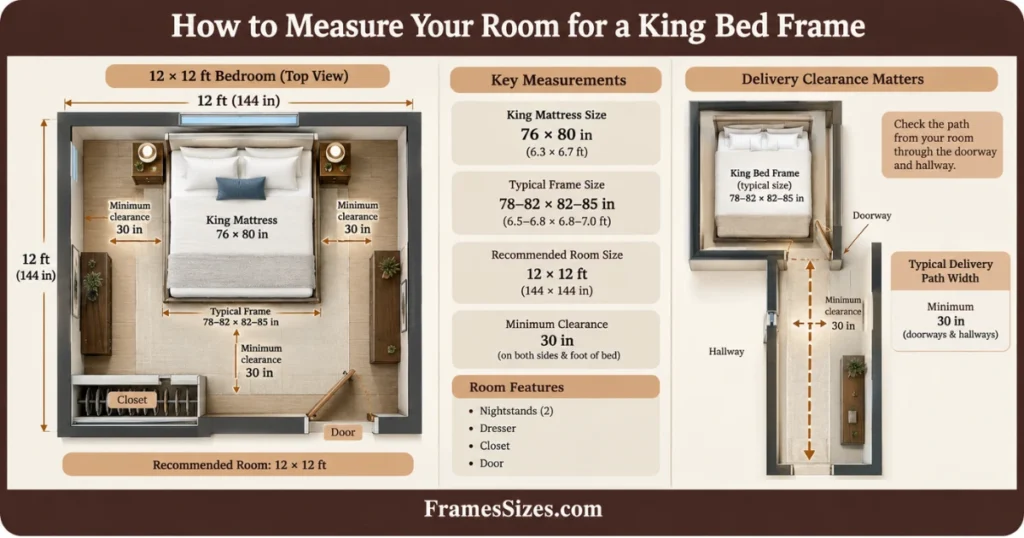
Most sources agree a king bed fits best in a room at least 12 by 12 feet, or 144 square feet. A king can technically squeeze into a smaller room, but there won’t be much space left for a dresser or nightstands.
Clearance Space Around a King Bed Frame
Leave at least 2 to 3 feet of open space along both sides and the foot of the bed. Interior designers often recommend a minimum of 30 inches so drawers open freely and the bed is easy to walk around.
How to Measure Your Room for a King Bed Frame
Start by measuring wall to wall, then subtract space for doors, closets, and any furniture that’s staying put. Next, measure the delivery path, including hallways, stairwells, and doorway width, since a large headboard is usually the tightest fit.
Mark out the bed’s footprint on the floor with tape before you buy. It’s a quick step that catches sizing surprises before the frame ever shows up.
A comfortable bed frame height usually falls between 12 and 16 inches off the floor. That range lets most people sit on the edge with knees bent and feet flat, no matter the mattress size.
Slat Spacing and Center Support
King mattresses are heavy, so the frame needs real backup underneath. Slats should sit no more than 2.75 inches apart, and the frame needs at least one center support leg, ideally two, to stop the middle from sagging over time.
Who Should Buy a King Size Bed Frame?
A king size bed frame works best for couples who want personal space, families who co-sleep with kids or pets, and restless sleepers who move around at night.
Single sleepers can enjoy a king too, but the extra square footage mostly benefits people sharing the bed. If a current mattress already feels crowded, that’s usually the clearest sign it’s time to size up.
A few sizing slip-ups show up again and again when people shop for a king bed frame.
Buying a king mattress for a queen frame — it will overhang by 16 inches with zero support.
Measuring the mattress instead of the frame — the frame is always the bigger number.
Skipping the doorway check — headboards are usually the piece that gets stuck.
Ignoring slat spacing — gaps wider than 2.75 inches let the mattress sag over time.
Guessing on sheets — mattresses over 12 inches thick usually need deep-pocket king sheets.
Question About King Bed Frame Size
What is the standard king bed frame size?
A standard king bed frame size measures 78 to 82 inches wide by 82 to 85 inches long, built around a 76-by-80-inch king mattress.
How much bigger is a king bed frame than a king mattress?
Most king frames add 2 to 6 inches total in width and length, depending on the frame’s style and material.
What is the difference between a king and California king bed frame?
A California king frame runs about 4 inches narrower and 4 inches longer than a standard king, making it a better fit for taller sleepers.
What size room do I need for a king bed frame?
A room at least 12 by 12 feet, or 144 square feet, comfortably fits a king bed frame along with basic walking clearance.
Can I put a king mattress on a queen bed frame?
No. A king mattress is 16 inches wider than a queen frame and will hang off the sides without support.
How tall should a king bed frame be?
Most king bed frames measure 12 to 16 inches from the floor to the top of the mattress platform.
What size are king bed frame slats, and how far apart should they be?
Slats should sit no more than 2.75 inches apart to properly support a king mattress without sagging.
Is a king bed frame the same as an Eastern king bed frame?
Yes. “Eastern king” is simply another name for the standard king bed frame size, 76 by 80 inches.
What sheets fit a king bed frame?
Standard king sheets fit mattresses up to about 12 inches thick. Anything thicker usually needs deep-pocket king sheets.
Is king the largest standard bed frame size?
No. Oversized options like the Wyoming King, Texas King, Alberta King, and Alaskan King all exceed standard king dimensions, though they’re far less common in stores.
Conclusion
Now that the real king bed frame size is clear, from the standard 78-82 x 82-85 inch range to how it shifts by style, measuring your room and avoiding the common mistakes above should be simple.
Hi, I’m Adrian Blackwell, the author at FramesSizes.com. I help simplify measurements, dimensions, and frame sizes with easy guides and clear explanations — so you can understand sizes quickly and accurately.