The most common poster frame sizes are 11×17, 18×24, 24×36, and 27×40 inches. Movie posters use the 27×40 one-sheet size, while 18×24 is standard for concert prints. Match your frame to the poster’s exact dimensions, or add 2 to 3 inches per side if you want a mat border.
This guide covers every standard poster frame size, from small event flyers to full movie one-sheets, plus how to pick mats, glazing, and materials that protect your print for years.
Standard Poster Frame Sizes Chart
A visual comparison of standard poster frame sizes, from 11×17 inch flyers to 27×40 inch movie one-sheets.
Four sizes dominate the US market: 11×17, 18×24, 24×36, and 27×40. These cover almost every poster you’ll buy or print, from dorm room art to full movie posters.
Mid-range sizes like 16×20 and 20×30 fill the gaps between these four, especially for gallery walls or home office decor.
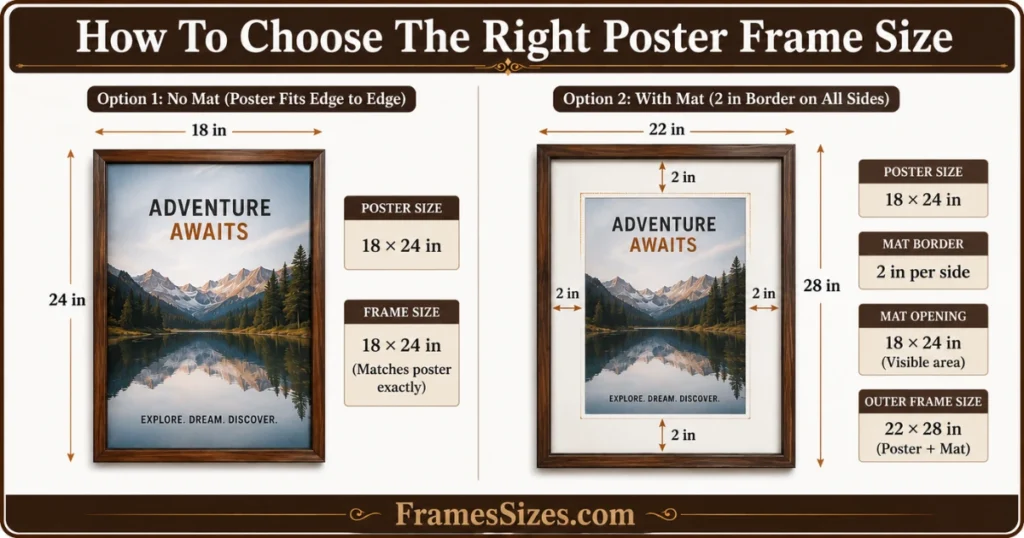
An 18×24 poster fits directly into an 18×24 frame, while adding a 2-inch mat border requires a larger 22×28 outer frame.
Start by measuring your poster itself, not the wall space around it. What size frame do I need for my poster? Match the frame to your poster’s exact width and height first.
If you want a matted look, add roughly 2 to 3 inches per side to the poster’s dimensions. An 18×24 poster with a mat typically needs a 22×28 or 24×30 frame, not an 18×24 one.
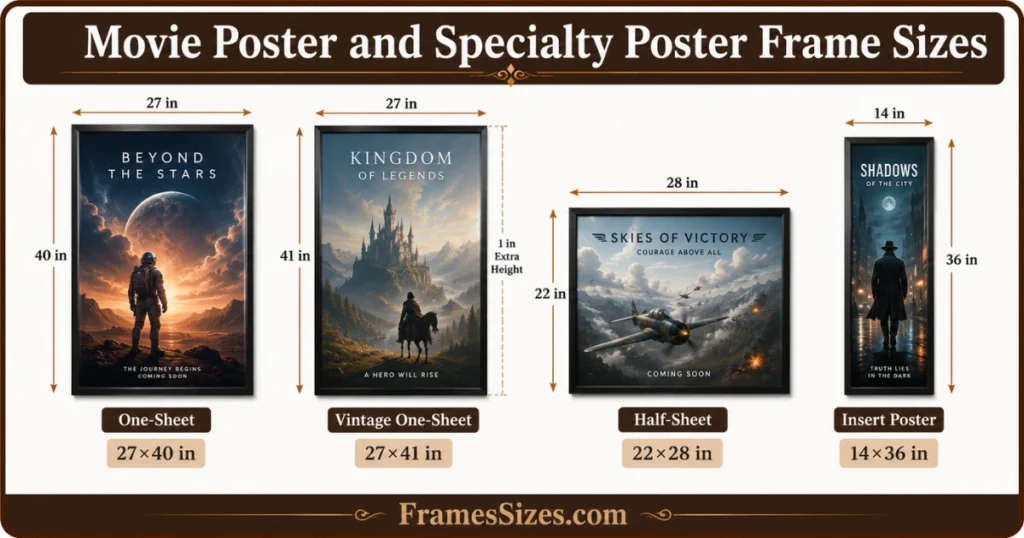
A visual comparison of classic movie poster formats, showing the size and proportion differences between one-sheets, vintage one-sheets, half-sheets, and insert posters.
The movie poster industry settled on 27×40 inches as its standard “one-sheet” size in the 1980s. Older prints often measure 27×41 inches instead, so always measure vintage pieces before framing them.
Smaller theater formats include the half-sheet (22×28 inches) and narrow insert posters (14×36 inches). Concert posters mostly use 18×24 inches today, though vintage 1960s prints ran closer to 14×22 inches.
International posters add another wrinkle. A European A2 poster measures roughly 16.5 x 23.4 inches under the ISO 216 paper standard — close to, but not a clean fit for, US 16×20 or 18×24 frames.
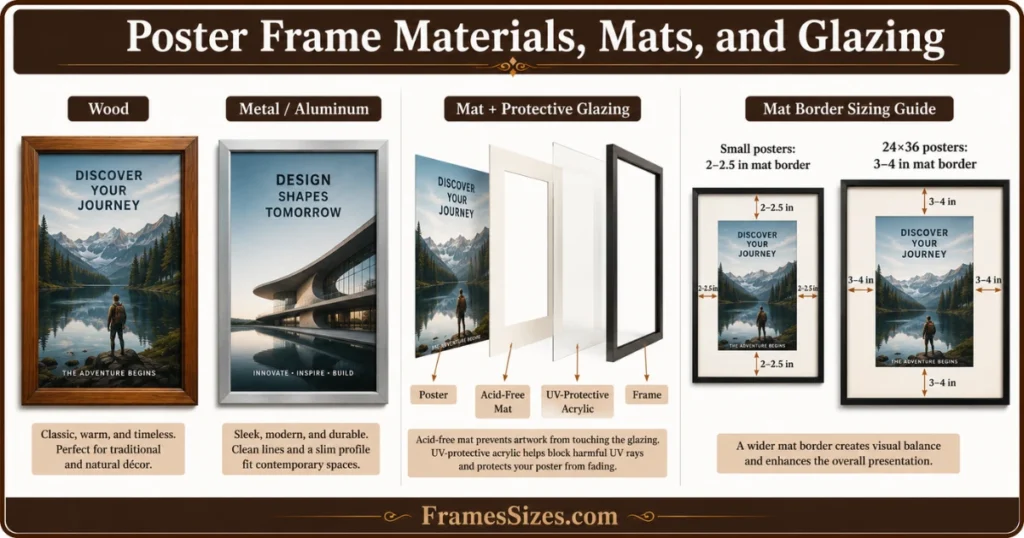
Compare wood and metal frames, understand protective framing layers, and choose the right mat border size for your poster.
Wood frames add warmth and suit home decor. Metal and aluminum frames give a slimmer, modern edge and hold up better in high-traffic spaces like offices or hallways.
For protection, choose acid-free matting to stop yellowing, and UV-protective acrylic glazing to slow fading from sunlight. Standard mat borders run 2 to 2.5 inches on small posters, growing to 3 to 4 inches on 24×36 prints.
Question about Poster Frame Sizes
What are the most common standard poster sizes?
The most common sizes are 11×17, 18×24, 24×36, and 27×40 inches, covering small flyers up to full movie posters.
What size frame do I need for my poster?
Match the frame to your poster’s exact dimensions if unmatted, or add 2 to 3 inches per side if you want a mat border.
What is the standard size for a movie poster?
Modern movie one-sheets measure 27×40 inches. Posters printed before the 1980s often measure 27×41 inches instead.
Is 16×20 a good poster size?
Yes. It’s a popular mid-range choice for art prints and gallery walls, smaller than 18×24 but still large enough to stand out on a wall.
Can I use the same frame for horizontal and vertical posters?
Many poster frames support both orientations, especially ones with reversible or dual-direction hanging hardware. Always confirm the listed dimensions match your poster either way.
Conclusion
Picking the right poster frame size comes down to one habit: measure the poster before you shop for the frame. Match that measurement to a standard size, decide on a mat, and choose glazing that protects your print for years to come.
Hi, I’m Adrian Blackwell, the author at FramesSizes.com. I help simplify measurements, dimensions, and frame sizes with easy guides and clear explanations — so you can understand sizes quickly and accurately.